

How RFID has become the bane of my existence
It’s my first day of the season at one of our local ski hills, so I open our junk drawer, rifle through a stack of 30 odd plastic cards—mostly RFID cards from ski resorts we visited over the past couple of seasons, but also a few arcade and movie passes and a library card. I grab my Powder Mountain pass, and tuck it neatly into my sleeve pocket. And for the rest of the season, whenever I ski PowMow, I ski right to the chair, occasionally waving that arm in front of the sensors when the gates don’t open promptly.
That is until the weather starts to warm up, and I switch to a lighter jacket. I grab the pass from the old coat, and dutifully transfer it to the new one. As I approach the gates, I am buzzed like I’d missed a question on Family Fued. The gates hold firm. I hand the card to the lift attendant, who scans it, and says, “This is last year’s pass. It’s inactive.” As it turns out, when I renewed my pass, I was handed a new RFID card, which I apparently stashed away in my coat pocket, and promptly forgot about, just as intended.

The RFID card has become the bane of my existence. As a family of four that travels to ski areas throughout the country—for work, kids competitions, and recreation—we are swimming in little plastic cards. On the surface, and when they work as intended, there’s no question the RFID system adds a layer of convenience. My fifth grader, for instance, buys a pass through Ski Utah that is good for three days at all member resorts, and it’s really nice to be able to load last year’s RFID card, skip the ticket window, and head straight to the lift. But that’s all assuming last year’s card wasn’t lost or tossed in the trash because he needed that pocket for a different pass.
This, of course, comes at a cost. Most resorts now charge you up front for the “media,” and charge you again to replace it. We not only pay for a ticket to access the lifts, but also pay for the actual, physical ticket. And nobody bats an eye. In the RFID age, this has become completely normal, but in context it’s really not. Could you imagine if Killington, upon introducing the Hanley Ticket Assembly (aka the wicket) in 1963 added a 50-cent charge for the little piece of metal? “But hey, bring back your wicket next time and save the 50 cents. But not just any wicket, it has to be this one.” This is airline level nickel-and-diming. What’s next? A fee to lower the footrest? A surcharge to turn on the heater in the bubble chair?
The RFID has also eliminated an element of interpersonal engagement. The first interaction with a resort was often being greeted by a liftie as they scanned you for a dangling day ticket or checked the photo on your pass. A smile, a friendly hello, and maybe a chuckle or a comment on the asinine pass picture you so carefully planned. Nowadays, the lifties are still there, but instead of making eye contact, they are glued to a tablet—a microcosm of so much that is wrong right now. Purportedly they are making sure the hatless, goggleless, pixelated picture corresponds with the helmeted, goggled, hopefully snow-splattered face coming through the line, but we don’t know that for sure. In my imagination, they’re just video chatting with mom. No more face time with the liftie because the liftie is on FaceTime.
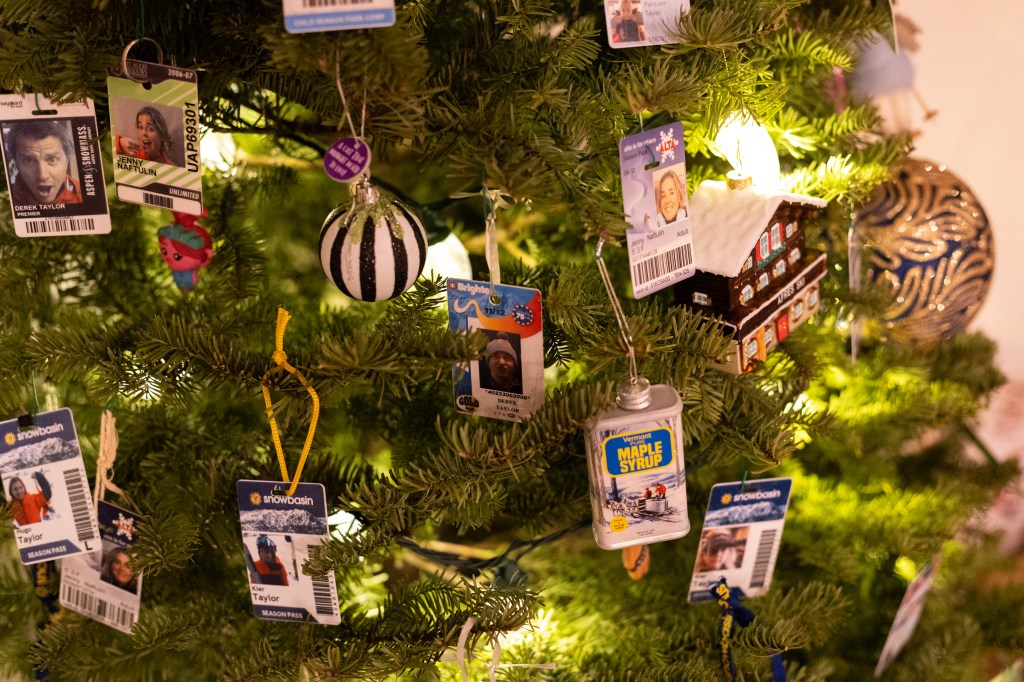
The real kicker came this Christmas when we started to decorate the tree. We have a few traditional ornaments, but most of our decorations are old ski passes—snippets of seasons past. We have the first three years of my youngest’s life, when he went by the name Pancake and fish-hooked himself in every photo. And there’s both of our kids’ first passes, when they were still too young to walk and we happily paid $25 for a piece of “media” that we knew would never be used to access a ski lift. The year we first started dating, when my wife and I skied Alta together. The perm I got after losing a bet that is now immortalized on my 2012 Jackson Hole pass. Many fond memories of years we spent skiing places like Aspen, Brighton, Mt. Hood Meadows, and Snowbird.
Snowbasin, where we’ve spent most of our ski days over the last 13 years, went to RFID this year. It was billed as, and in all fairness is, a major resort upgrade. But as I hang passes on the tree, the realization sets in that there will be no new goofy photos and memories to hang on the tree. Just faceless pieces of plastic embedded with silicon and copper stashed away in a coat pocket or junk drawer.
I’m very cognizant that this is a first world… I wouldn’t even call it a problem. Just a very privileged pet peeve. I’m also well aware that I’m now the old man yelling at a cloud. The ski pass photo, like the wicket, isn’t coming back, relegated instead to a handful of nostalgic holdouts scattered across the ski landscape. RFID is here to stay, at least until the next great innovation comes along for me to complain about. And at this point, I’m ready for it. Just chip me like a rescue puppy and let’s get on with it.
Derek Taylor is the former editor of Powder Magazine and a writer and photographer for various outdoor media outlets. He and his wife, Jenny, are the owners of the Smuggler’s Chalet.
 smugglers-chalet.com